*[text]
* [works]
*[cv]
*[agenda]
*[links]
*[contact]
*[back]


art organizations

Post St Joost Institute

KOP

RijksAkademie

Billytown


artists

Noriko Mitsuhashi

Susanne Bruynzeel

Kisuke Kinoshita

Alice Nikitinova
*[back]
*[installation]
*[video]
*[back]
Rumiko Hagiwara
Egelantiersstraat 48/50 I, 1015PN, Amsterdam, Netherlands

hagisan1@hotmail.com

*[back]
"BELICHT"

Galerie de Expeditie
Zsa-Zsa Eyck
opening 6th saturday 17:00-19:00
6/September till 25/October 2008
Wednesday-friday11:00-18:00hrs
Saturday14:00-18:00hrs

Leliegracht47, 1016GT, Amsterdam
Galerie de Expeditie
"Dear-Delighted-Site"

Kop Opening 21st of November 2008
opening hours:13.00 till 17.00

Friday, Saturday and Sunday

Speelhuislaan 171, Breda
KOP
"Rijksakademie Open"

Rijksakademie van beeldende kunsten
Saturday 29th and Sunday 30th November 2008
opening hours:11a.m. - 7p.m.
Admission fee including publication 4 euros,
with reduction pass (CJP, Pas 65, Stadspas and Student card) 3 euros,
weekend pass 5 euros, children up to 12 free

Sarphatistraat 470, 1018GW, Amsterdam
Rijksakademie van beeldende kunsten
*[back]


How can we escape from the frames in daily life?


I like this story in Japan that goes like this:
One day, a person was walking to his home. He walked down the road he walked on a daily basis. He noticed there was a rock on the ground. His mind was opened suddenly by noticing a trivial thing. He felt there was a god here, and that he stood in another world. He saw that his daily view was changing.

I think phenomena of the world surrounding us always have some kind of system bounds or frameworks, but we are not aware of being part of such bounds in spite of the fact that all bonds come from just this daily life. I have grown up in a small society of the countryside in Japan where traditional manners exist. These traditions made me feel choke, so I tried to escape from these chains and be free. This was the starting point where I became involved in art. But I was still in bounds by an unconscious mind.

Now I think that, rather than trying to escape from the chains of daily life, freedom and art can exist along within these bounds. We are looking for something outside our position but we can never exist outside our daily basis. This made me wonder: if we change our ways of seeing things in daily life, can we than start moving towards the outside framing, even though we are inside? This means pursuing a parallel, a method of making a distance between you and the phenomena for the coexistence in the world.

My works consist of tiny changes in space(s). Spaces have memories and time remained by actions of people. These memories can easily be ignored in daily life but with my work I point the attention of the viewer to it. In one of my installations I made a line with transparent tape following the shape of the corridor we walk down every day. By making some 200 layers of tape this line became very thick and white because of the air and the dust in between the layers. Through this work people became aware of the line made by daily stuff on the ground for the first time. From that point their view went up, followed along the surface of the corridor, and spread out the space. The action in a process like this can be more important than the work itself. The wall was just there and the light on the ceiling was just there. But because of my work the viewer could look down at a daily situation from far away.

You can hide a certain object in front of you on purpose. Then, your mind is opened adversely, because nothing is shown. Your view cannot be controlled or attracted by any particular point of attention, and there are no structures or lines forcing a connecting stream between you and that point. Therefore, you feel liberated. You are able to pay attention to the surrounding nature that is always next to you and that makes you alive.

I propose that everything is just there and if you change a point of view in daily life, you can transfer to another world just as if you where outside that daily frame. I find the attitude or stance to keep that up, beautiful. I think we should continue this act of tiny changes to confront the frame in the world.


*[back]


Rumiko Hagiwara Curriculum Vitae


Birth:
Tomioka, Gunma, Japan 12/09/1979
Education:
Rilks Akademie van beeldende kunsten, 01/2008 ~ 12/2009
Post St.Joost Institute,Department of Fine Arts, 09/2006 ~ 08/2007
Royal Academy of Fine Arts, The Hague/KABK, Department of Fine Arts, 09/2005 ~ 07/2006
- research student
- major areas of study: 3D department
Royal Academy of Fine Arts, The Hague/KABK, Department of Fine Arts, 02/2005 ~ 06/2005
- exchange program student
- major areas of study: 3D department
Tokyo Zokei University, Department of Fine Arts, 2004 ~ 2005
- research studen
Tokyo Zokei University, Department of Fine Arts, 2000 ~ 2004
- major areas of study: Conceptual course
Group Exhibitions:
BELICHT, Galerie de Expeditie, Amsterdam, 06/9/2008 ~ 25/10/2008
Billytown 2007, billytown, Rijswijk, 17/10/2007 ~ 22/12/2007
bigPOWERsmallWORKS, Galerie KATHAREZE, Tilburg, 1/12/2007 ~ 29/12/2007
Set scene and Decor, W139 basement, Amsterdam, 02/2007 ~ 08/2007
Film night, SM-S Stedelijk museum 's-Hertogenbosch, 10/05/2007
PRE SENSATIE, Lokaal 01, Breda, Netherlands, 31/04/2007 ~ 06/04/2007
LIFE ART KOP Breda, Netherlands, performance evening, 12/01/2007
OPEN, Public Space Den Bosch, Netherlands, public space project in Den Bosch, 17/11/2006
KAILASH, studio BIG ART,Yokohama, Japan, 26/12/2004 ~ 06/01/2005

Solo Exhibitions:
JUST, Gallery Red Hot, Den Haag, Netherlands, 10/03/2006 ~ 16/03/2006
UNLIGHTING Gallery node, Tokyo, Japan, 12/09/2003 ~ 17/09/2003
Grants:
Rijksakademie van beeldende kunsten/Dutch Ministry of Education, Culture and Science, 2008
Fellowship 2006 of Tokyo Zokei University, 07/2005 - 06/2005
Exchange program 2005 of Tokyo Zokei University, 02/2004 - 06/2006
*[back]
*[back]
foot steps, 2008, 69x133cm, inkjet print
There was the photo of the floor in the space. The photo was printed as exactly same size of the real size and lying at same place. When the photo was taken, there were many foot steps on the floor. After that they were cleaned but these foot steps are remained in the photo as memory of the space.
*[back]
circle, 2008, 20x14.5cm, inkjet print
There was a circle object on the ceiling in the space of the gallery. I took the photo of the object and presented it on the wall in the same space.
*[back]
square, 2008, 20x14.5cm, inkjet print
There was a square door on the floor in the space of the gallery. I took the photo of the square and made a composition in the frame. And I presented it on the wall next to the real square door.
*[back]
space between black and white, 2008, 15x9x7.5cm, Flip book, inkjet print
This is the book that you can flip from black to white or white to black. The images of the book become an animation. The white color become a circle and get smaller and smaller. You would look the ping pong ball in between. At the end it is going to disappear in the universe and fade in black.
*[back]
the Basketball in the center of the space, 2008, basketball
There is a basketball hanging in the middle of the exhibition space. You are demanded to recognize where the exactly center of the space is. There is the logotype, all surface‚Äö on the basketball, I used this word as the title of the exhibition. This is related with all my works in the space because it is in the center of the space and all surfaces.
* [back]
reversed boxes, The projectroom south in de Rijksakademie on 9th of June 2008, 7.5x8x5cm, paper box printed inkjet
I made ten boxes that have the photo of the exhibition space in each side. People can hold them on their hands and walk around the space with it. Each side box photo has the photo flipped as mirror of the space because the box is the small space reversed exhibition space. You are inside of the space at the same time outside of the space.
* [back]
blue square, 2008, tripod, mirror(5x5cm)
The square mirror on the top of the tripod is aiming the direction of sky at the front of the big window inside of the space. The mirror reflects only sky blue that is the color in the air faraway outside. You get compressed interval space as just blue square at front of your face.
* [back]
flash light, 2008, flash light, installation combined with photo representation
I inserted the flashlight in the small space of the socket in the corner of the dark space. Light reflect inside round space and come out. To make different perspective of perception, I hang up the documentation photo of the work on the way to come the installation space. People see the photo documentation before or after they see the real installation.
* [back]
two triangle, 2008, inkjet print(130x190cm), photo installation
I took the photo of the floor and the part of the wall at the certain time, which is lying at the exactly same place where the photo was taken. The time that the photo was taken remained second triangle in the photo because there is the sun light reflection on the floor came in the area of the photo. Each moment the real sun light reflection came in the frame as third triangle, but the first one and second one is stuck with space as a moment of the space.
* [back]
a triangle , 2008, polaroid film
The photo of the corner in the space. I hang the photo up side down on the wall next to the corner where the photo was taken.
*[back]
half past 4, 2007, collaboration with Susanne Bruynzeel, silver sticker,
collaboration with Susanne Bruynzeel. In the empty space, we stand at the cirtain point and took the shape of the light through the side windows on the floor, at half past 4 on 17th of October. We put silver stickers in the area of the light in order. when people walk around the area, you see different light refrection on the stickers, but you can't see the whole images of the light. It become visible only soroundings of the point you are standing, because of the light perspective. And the real light area never be overlap with stickers area on the floor. Time is passing.
* [back]
tennis ball
2007, installation and photo(100x75mm)
The combination work with the photo and the installation. There are some tennis balls installed in the exhibition space where people don't notice. On the wall, one photo are hunging up that taken in a moment tennis ball is almost falling down from the couch in the train.
* [back]
unlighting-in the room-in the kitchen-in the study room-in the droppipe-in the hole,
2004, 5 digital pictures
These are installations in daily life situation. I dropped the light, which is usually over our heads, onto the table. We can only see a sliver of light escaping from the cover. I think that light is different from the light in daily life. So, we look down at daily life from far away. I think we can transform the world into another when we change our ways of seeing things in our daily life.
* [back]
blue filter, 2005, wood, nylon
I tried to make a filter at the entrance. You could look outside through the blue filter from inside. But you could not look inside from outside, you could only see the blue. The view through the blue filter is another view which is not in daily life.
* [back]
box, 2004, 30x30mm, paper
I made a crane made from paper. Then I cut two wings, neck and tail.
It is a remaining torso of one paper crane without them.
* [back]
closed, 2006, steel, orange net
'OPEN' Public Space, Den Bosch One day project of first year Post St Joost in the center of Den Bosch. Location: Outdoor Car-Park,

There is a box which is the exact size of the parking space.
In the open space, people come and go, without defining the spatial boundaries.
The box is closed but its inside is empty.
The frame which shows my own space is just here.
* [back]
gate, 2006, transparent tape
I made a line following the shape of the corridor we walk down every day, with transparent tape. By making many layers, it became thicker and thicker, and white because of air and the dust in between layers. You notice the line on the ground at first, then your point of view goes up and follows along the surface of the corridor. The wall is just there and the light is just there.
* [back]
one line of them, 2006, toothpick
There are some cracks in the floor. I put toothpicks into cracks as a line. I didn't design this line of toothpick, just selected one line which divided the space.
* [back]
one piece of wool, 2005, wool
I put a red wool string in the gaps between the floor boards. Then I tied it into a bow tie in the center of the room. the line is going to around the room and come back to the center of the room.
* [back]
one thousand paper cranes, 2004, 70x70x70mm, acrylic, ash, water
I made one thousand paper cranes, a symbol of prayer, from origami. (Origami, or paper folding, is a Japanese tradition. One thousand paper cranes are often made in Japan when we pray for recovery from sickness or for peace.) A month later, I burned it. I mixed the ash with a bit of water in a cubic box. Finally, I set it up on a wall, a little above my own eye height. I enjoyed this process.
* [back]
pyramid, 2004, 500x500mm, toy bullet
I arranged toy bullets to make a solid square. Next, I began to layer them, using the gaps in the square form of the bottom layer. I made several layers, and formed a pyramid. Then I turned it upside down. It is standing, balanced on one point.
* [back]
a shuttle, 2006, shuttle
I put a shuttle on top of the wooden paneling of the wall. This is just here.
*[back]

*[back]
black points, 2004, 85x11mm, 10 instant films
I took the 10 pictures of the sun by instant camera. The black point appeared in the middle of sun, where the brightest point should have been.
* [back]
a wall, 2005, white paper
I put pieces of white paper on the wall. Then I tore it only along the sides. It looks like a broken wall.
* [back]
in shadow
2007, installation, graphite
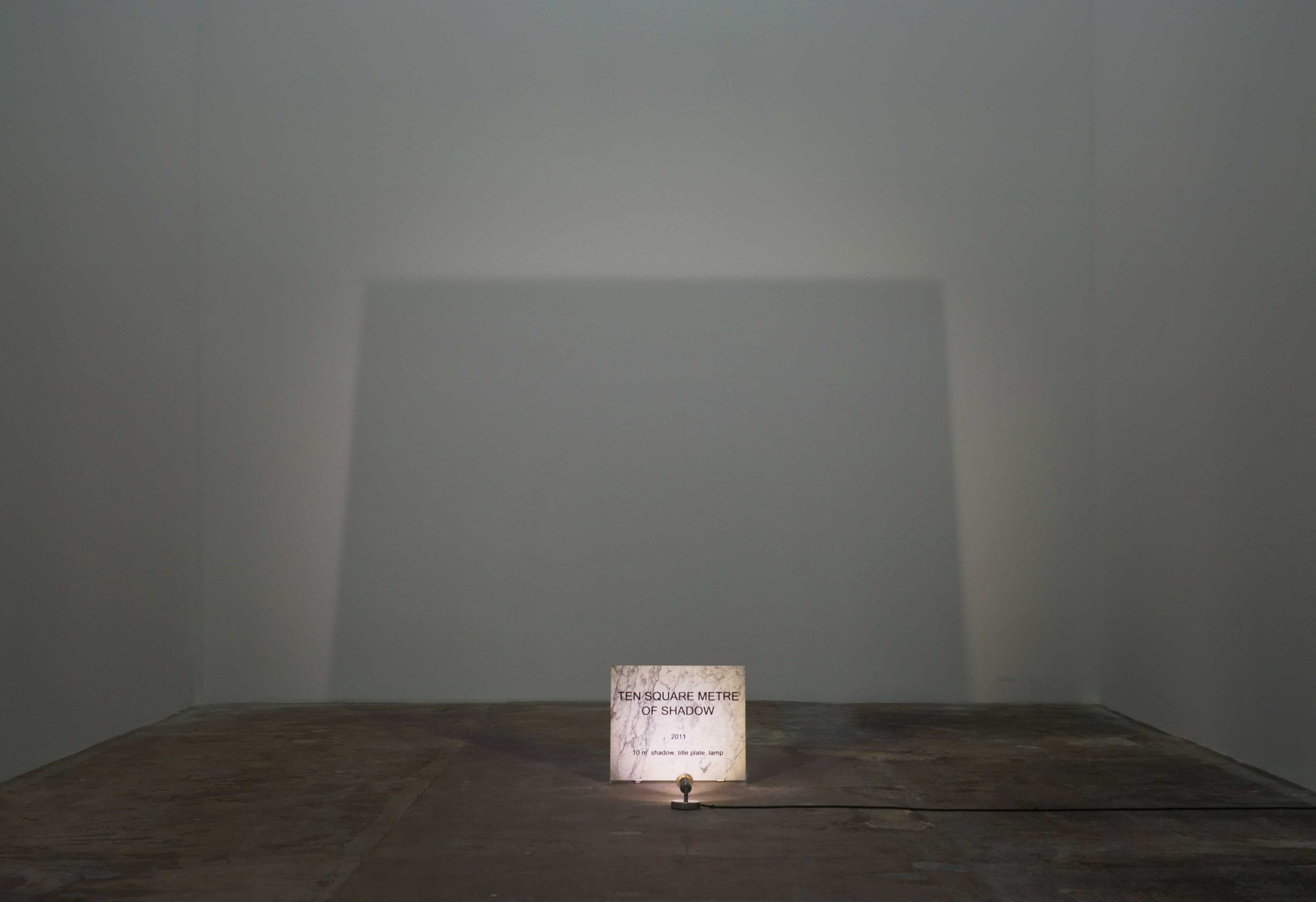
There is a shadow at the corner of the space. When people step in the shadow, they notice the rough textures on the wall, floor, and shelling which has been made by people so far. The textures are appeared by same stroke pencil drawings covered with all shadow surface area. It makes the shadow is stronger and looks another space. I also made the piece of this shadow drawing at the entrance. People can connect them losing the interval of space. You can remove something front of you by noticing.
* [back]
closed02, 2007, installation, wrapping paper
There is a wrapping paper as a layer in the between of the box gellery which is located on the street so that people see works free.The wrapping paper hide inside so that nothing is shown. Only the light come outside through paper from inside, and you could see only the fold lines of the paper lighted up.
*[back]
Decor, 2007, installation, grope exhibition
The Decor was made the starting point of the exhibition. A set is there to create a framework, to guide meaning, to frame time and space and as a background to stories.I made a baseground as a work in the small room located next to big exhibition room. By covering grid line of the masking tapes, the room became a refrection of next room. i traced next room into small room by scaling and cutting nothing area on the scale lines, which is linked other works in next room.People see real works at the first and next see the refrection of the works in my work. All frames of setting are overlapping in my area.